
Aviation roofing in Charleston runs on the airport's clock, not ours
An airport never has an off-season or an overnight when the building is empty, and that single fact reshapes every roofing decision before a sheet of membrane is ordered. West Virginia International Yeager Airport, CRW, is the state's primary commercial field serving Charleston and the Kanawha Valley, and it has a feature almost no other airport shares: it was built by shearing the tops off several ridgelines and filling the valleys between them, leaving the terminal and runway perched on an engineered mountaintop plateau above the city. That site drives hard rain runoff, exposes the buildings to ridge-top wind, and leaves no room for sloppy drainage. Every access point, material lift, and crew movement on a project here has to be cleared through the airport's facilities department, the FAA Part 139 safety program, and in places TSA security. We build that coordination into the scope at bid time instead of discovering it after the trucks arrive.
The campus is bigger than the terminal
Aviation roofing in Charleston is not just the passenger terminal. The same airfield supports cargo buildings, the rental-car center, fixed-base operator hangars, aircraft maintenance facilities, and support structures, and the region is fed by reliever and secondary fields as well.
- West Virginia International Yeager Airport (CRW)- the primary commercial airport on its mountaintop site serving Charleston and the Kanawha Valley
- Tri-State Airport (HTS)- the commercial field at Huntington serving the Tri-State region to the west
- Greenbrier Valley Airport (LWB)- general aviation with limited commercial service along the Greenbrier resort corridor
Security clearance does not disappear just because the work moves off the terminal and onto a cargo apron or a hangar row. Badging and escorted access apply across the whole campus, and our crews plan for that rather than running into a locked gate on the first morning.
Terminal roofs carry loads ordinary commercial roofs never see
The systems on a terminal go beyond a standard single-ply field. Airside roofs catch jet blast, which means the membrane adhesion or ballast has to be rated well past what a comparable warehouse would ever need. Terminal mechanical systems are denser and heavier than typical commercial, so the roof carries more curbed penetrations and more flashing maintenance points per acre. And terminals tend to be long, flat, lightly sloped expanses where drainage design is everything and the tolerance for standing water is essentially zero, a problem made worse by the volume of rain that comes off CRW's exposed plateau. We design these roofs around drainage and uplift first and the cosmetic membrane choice second.
High-bay hangars are their own structural problem
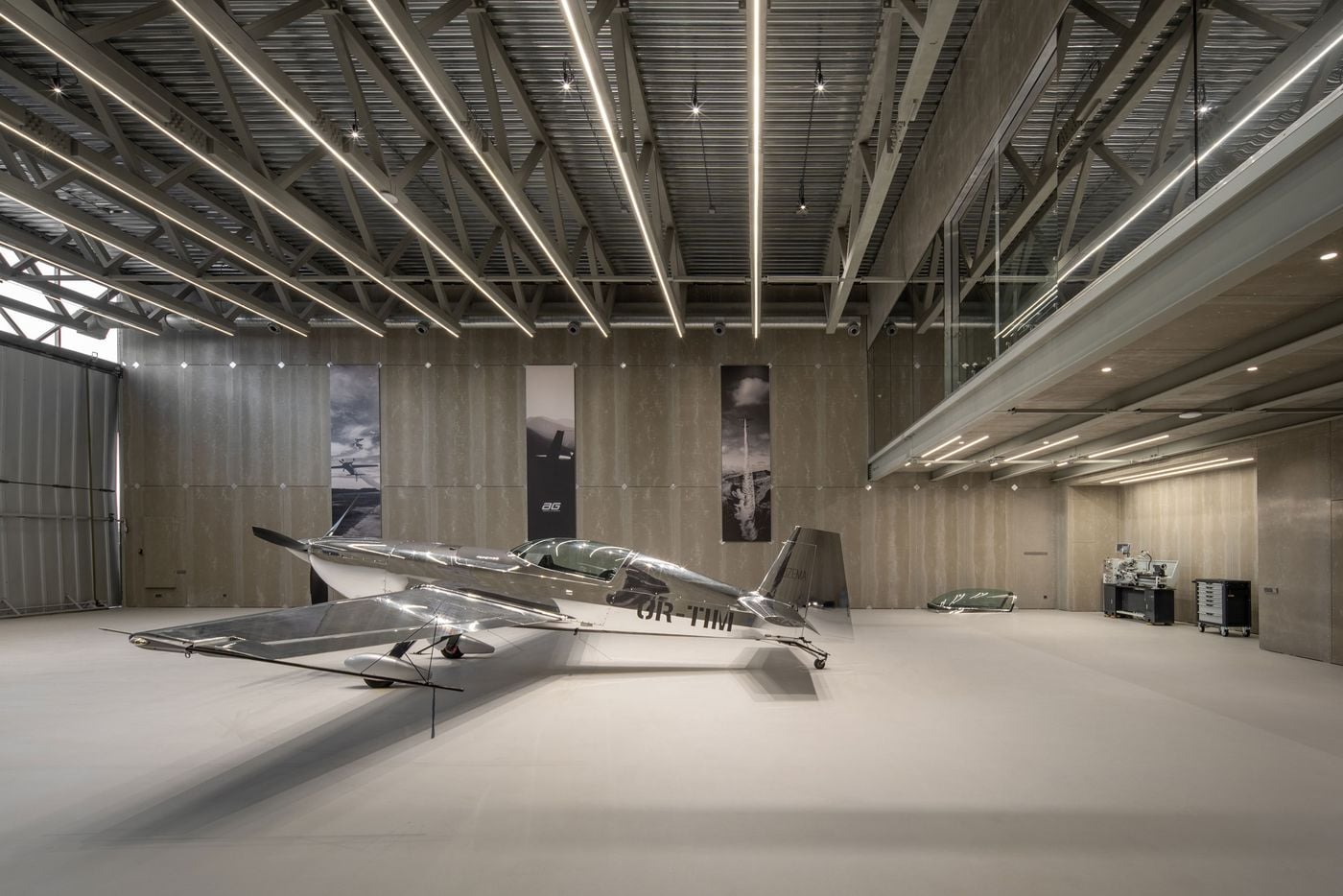
General aviation work shifts the challenge from security to structure. FBO and private hangars are tall, wide, clear-span buildings, frequently pre-engineered metal systems or wide-flange steel, and they generate serious wind uplift across that open span. The fastening pattern and seam geometry have to be matched to the building's real uplift and thermal-movement behavior, not borrowed from a low-rise commercial detail. On exposed reliever-field sites the wind exposure is often higher than at the shielded terminal, so the spec has to account for it. We install standing-seam metal and single-ply systems on these structures throughout the region and engineer the attachment to the building in front of us.
How we run a job on a live airfield
We develop a phased work plan with the facilities department and the Part 139 coordinator and get it approved by airport operations before mobilizing. Material deliveries, crane lifts, and anything near airside areas go into approved windows and, where required, into the FAA NOTAM process. Crew credentialing for airside authorization is confirmed before anyone steps onto a controlled apron, and we will not put an uncleared worker in a secure zone to save a day. Our pre-project survey documents every penetration, curb height, and mechanical clearance so the flashing for oversized equipment is engineered individually rather than improvised. For most terminal reroofs we specify a TPO, PVC, or KEE single-ply on tapered insulation to fix drainage and kill ponding; for new high-bay hangars we usually move to standing-seam metal. The final spec comes after we walk the roof with your facilities engineer, because an airport roof is not a building we want to learn on.
Airport & Aviation Roofing Questions
How do you handle scheduling at an operational airport like Yeager?We build a phased work plan with the facilities department and the FAA Part 139 coordinator and get it approved by airport operations. Deliveries, crane lifts, and any airside work go into approved windows and into the FAA NOTAM process where required. This is a standard part of our project setup, not an exception.
What roof systems are standard for large-span terminal roofs?Most terminal reroofing uses a TPO, PVC, or KEE single-ply on a tapered insulation system to improve drainage and address ponding. New high-bay aviation structures and hangars are often standing-seam metal. The choice depends on the existing deck, load capacity, and operational constraints, and we develop the spec after walking the roof with your facilities engineer.
How do you deal with the density of HVAC and mechanical penetrations on terminals?Terminal mechanical density runs well above standard commercial. Our pre-project survey documents every penetration, curb height, and clearance before we build the work plan, and flashing for oversized curbs and complex through-penetrations is engineered individually rather than using standard low-rise details.
Can you work on airside structures near active runways and aprons?Yes, with appropriate badging and full coordination with airfield operations. Airside work needs a higher level of pre-planning and crew credentialing, which we factor into the bid timeline. We do not mobilize crew without confirmed airside authorization.
Do you handle hangar roofing for FBOs and general aviation?Yes. High-bay hangar roofing, from a single-bay private hangar to a multi-unit FBO complex, is a regular part of our work. These wide clear-span steel and pre-engineered buildings have specific uplift and thermal-movement behavior, and we engineer the fastening and seam geometry to the actual structure.
Q&A
Questions about Airport Terminal & Aviation Facility Roofing
What decides the next roof step?
Moisture risk, membrane condition, drainage, access, roof traffic, rooftop equipment, age, warranty language, and building operations all shape the recommendation.
Can the building stay open during the work?
Often yes. The scope needs daily dry-in planning, staging notes, tenant protection, safety controls, and access limits written before field work starts.
What should ownership send before a roof walk?
Useful items include leak photos, prior proposals, roof plans, warranty paperwork, roof age, interior leak locations, and the best contact for roof access.
Related Roof Decisions

K-12 School Roofing in West Virginia
The first clue on K-12 School Roofing is often not the leak mark; it is the route water took between I-77 and Chelyan. We trace seams, drains, scuppers, curb.
→
Convenience Store Roofing in West Virginia
When an owner asks about Warehouse Roofing, we do not start with a brochure. We start with the weather, the roof assembly, the access route, the interior exposure.
→
Pharmaceutical & Laboratory Roofing in West Virginia
On a pharmaceutical or laboratory building, a leak is not a maintenance ticket. A few drops landing on a compounding bench, a sequencer, an incubator, or a.
→
Daycare & Childcare Facility Roofing in West Virginia
Childcare facilities in Charleston operate under a layered regulatory framework - local building codes, state childcare licensing standards, EPA RRP requirements.
→